13 Nov 2026
Patterns of Demographic Change Among Attendees of Prominent Poker Festivals

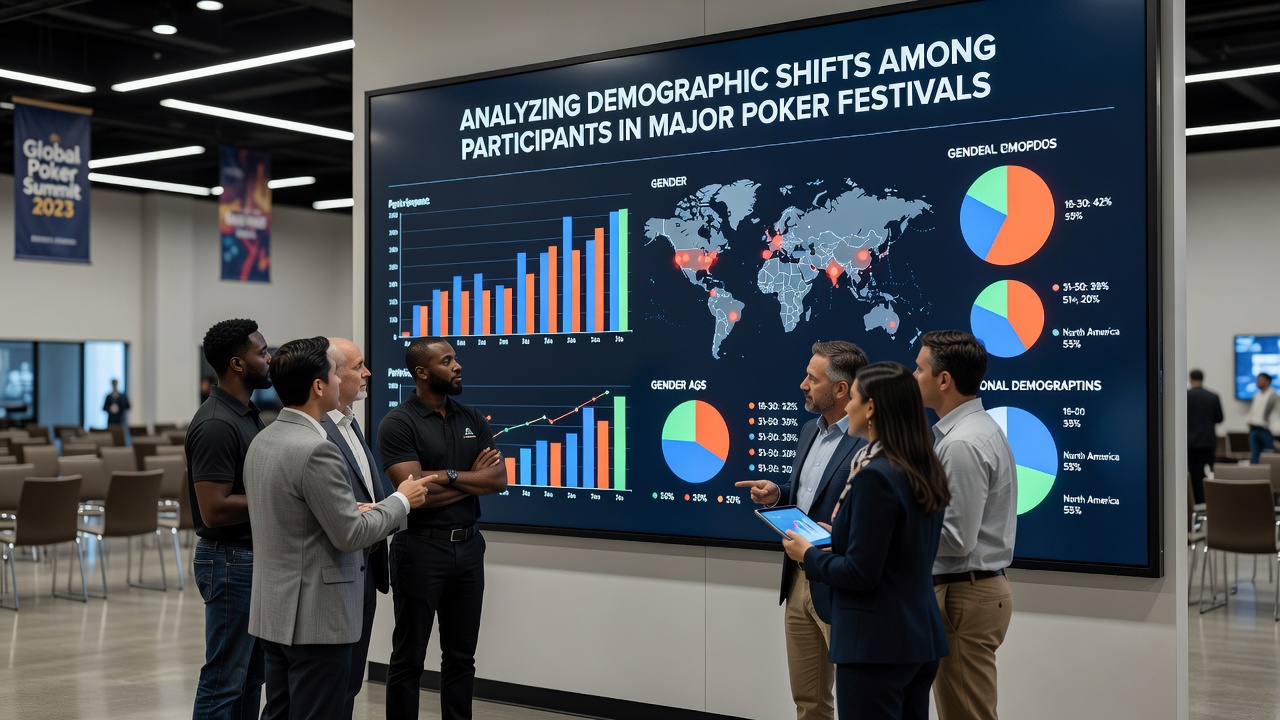
Attendance records from major poker festivals reveal steady adjustments in participant profiles, with data indicating shifts in age ranges, gender representation, and national origins across events held in Europe, North America, and Asia. Organizers track these patterns through registration databases that capture details such as birth years, self-reported gender, and passport information, allowing researchers to compile annual reports on who joins these gatherings. Studies from regulatory bodies show that the average participant age has declined gradually since the mid-2010s, while entries from players under thirty have increased in several flagship tournaments.
Age Distribution Adjustments
Registration figures from festivals in Las Vegas and London demonstrate that the proportion of entrants aged 21 to 29 rose from approximately 22 percent in 2018 to 34 percent by 2024, according to compiled statistics released by the Nevada Gaming Control Board. This trend aligns with broader access to online qualifiers that attract younger competitors who combine satellite wins with live appearances. Meanwhile the share of participants over fifty has remained stable near 18 percent, though absolute numbers have grown because overall field sizes expanded during the same period. Observers note that November 2026 schedules include several high-guarantee events where projections suggest continued growth in the younger cohort, driven by college-aged qualifiers who travel in groups.
Gender Participation Developments
Women’s entry counts have climbed in mixed-field festivals, reaching 12 percent of total participants at select European stops in 2025, up from 7 percent five years earlier. Data compiled by the Alcohol and Gaming Commission of Ontario indicates parallel growth in Canadian tournaments, where dedicated women-only side events have coincided with higher female turnout in main draws. These increases occur alongside targeted outreach programs that provide travel stipends and mentorship sessions, yet male entrants still form the clear majority across all monitored events. Researchers tracking longitudinal records emphasize that retention rates for first-time female players remain comparable to those of male newcomers when measured over three-year windows.
Geographic Origin Variations
Passport data aggregated from World Series of Poker Circuit stops and European Poker Tour stops show rising representation from Asian countries, particularly South Korea and India, whose combined share of non-local entrants grew by 9 percentage points between 2019 and 2025. European festivals report steadier inflows from Eastern European nations, while North American events draw larger contingents from Brazil and Mexico. A single external reference from the Nevada Gaming Control Board details how visa processing times influence arrival patterns for international players, with November 2026 festivals expected to reflect any adjustments in travel documentation requirements. Another report issued by the Alcohol and Gaming Commission of Ontario highlights similar cross-border movement statistics for events held in Toronto and Niagara Falls.
Nationality breakdowns also reveal that domestic players continue to dominate fields in their home regions, yet the percentage of repeat international visitors has risen steadily. Festival operators maintain databases that flag players returning for multiple consecutive years, and those records indicate that roughly 28 percent of 2025 entrants had competed in the same series during the prior two seasons. Such repeat attendance contributes to stable skill-level distributions even as newcomer demographics evolve.
Income and Occupation Indicators
Surveys conducted at registration desks capture self-declared occupation categories, and aggregated results point to increases in technology-sector professionals and students alongside declines in the share listing finance or sales as primary fields. These occupation shifts correspond with changes in average buy-in affordability, because many festivals now offer stepped satellite structures that reduce upfront costs. Records from multiple venues show that participants citing student status rose to 15 percent of fields in 2025, compared with 9 percent in 2020, while finance professionals dropped from 21 percent to 16 percent over the same span.
Conclusion
Comprehensive registration datasets from major poker festivals continue to document measurable changes in participant age, gender balance, geographic spread, and occupational backgrounds. These patterns emerge from consistent tracking methods employed by event organizers and regulatory agencies across different jurisdictions. Projections tied to the November 2026 calendar suggest further evolution in several categories, particularly among younger and internationally mobile entrants, as satellite pathways and regional outreach programs expand. The resulting profiles provide event planners with concrete figures that inform scheduling, marketing, and facility decisions for upcoming seasons.